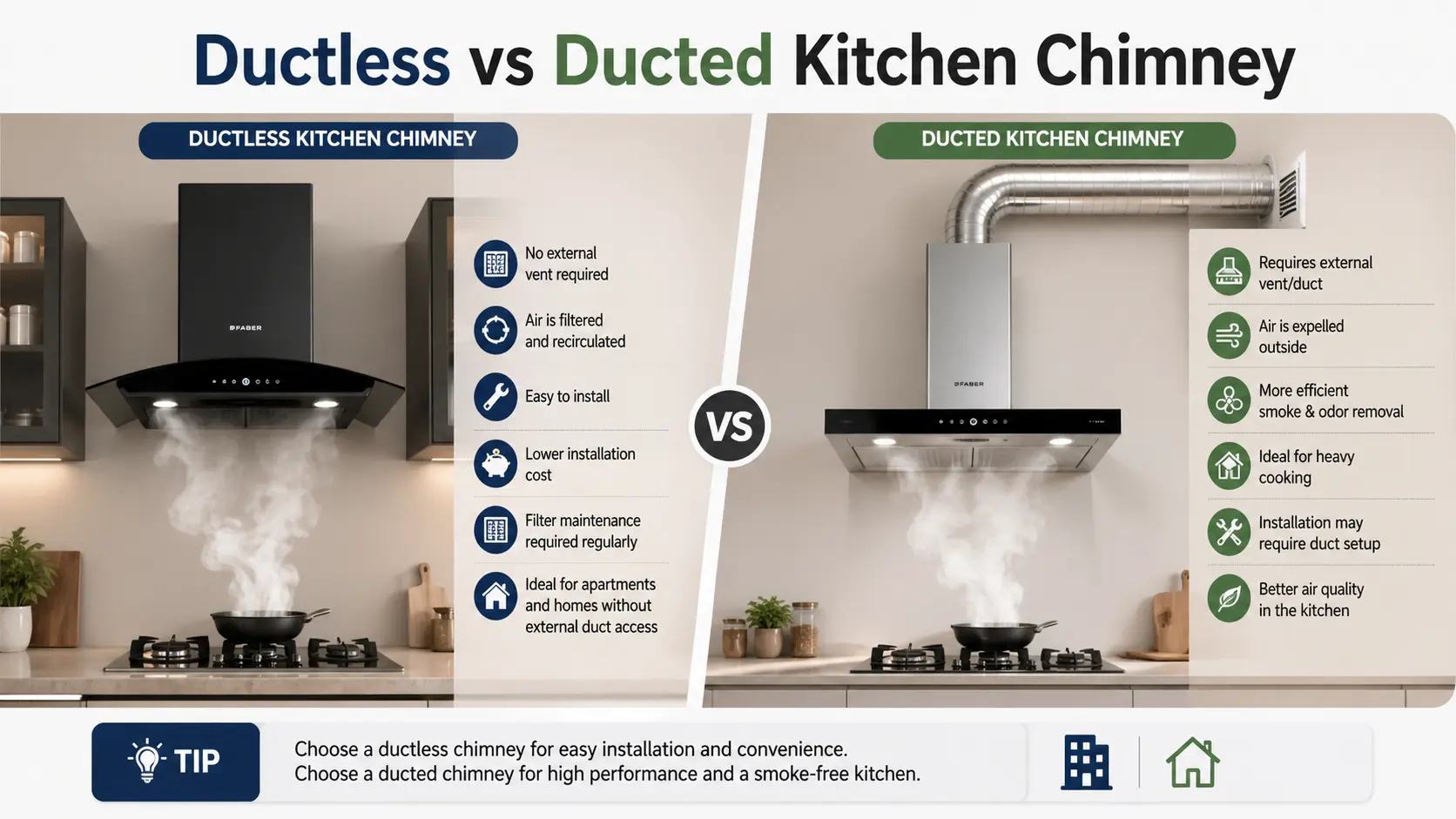
What Are Ductless and Ducted Kitchen Chimneys?
If you’ve ever stood in a kitchen appliance store or scrolled through a product listing feeling completely lost between “ductless” and “ducted” — you’re not alone. The ductless vs ducted kitchen chimney debate is one of the most common questions we get at Joyonn, and honestly, the answer matters more than most people think.
Getting this wrong means either spending money on a chimney that doesn’t actually clean your kitchen air — or drilling walls unnecessarily when a simpler setup would have worked fine. So before anything else, let’s be clear about what each type actually does.
Ducted Chimney (Vented / Exhaust Type)
A ducted kitchen chimney — also called a vented chimney or exhaust chimney — sucks up smoke, steam, oil vapour, and cooking odours, and then pushes all of it outside your kitchen through a metal duct connected to an external wall or roof vent. The air doesn’t come back in. It’s gone. This is the gold standard for heavy Indian cooking — think deep frying, tadka on high flame, continuous roti-making sessions.
Ductless Chimney (Recirculating / Filterless Type)
A ductless kitchen chimney — also called a recirculating chimney — draws in the greasy, smoky air, passes it through carbon filters and grease filters, and then pushes the “cleaned” air back into the kitchen. There’s no external duct needed. It’s easier to install, but the air stays inside your kitchen — just filtered
Quick Takeaway: Ducted chimneys remove air from the kitchen. Ductless chimneys recirculate it. That single difference drives almost every other comparison in this guide.
How They Actually Work
Inside a Ducted Chimney
When you turn it on, the motor draws air upward through the baffle or mesh filter that catches most of the grease. This grease-collected air then gets pushed through the internal blower and out through a duct pipe. The pipe runs through a hole in your kitchen wall or ceiling, exits the building, and releases the air outside. What you’re left with in your kitchen is actual fresh air — because the old air left the room.
Inside a Ductless Chimney
The process starts the same — the motor sucks air up. But instead of going outside, the air passes through activated carbon filters (charcoal filters) that absorb odour molecules. It also passes through oil-collector mesh filters that trap grease particles. Then this “filtered” air is released back into the kitchen from the sides or top of the chimney. The smoke is reduced, odour is reduced — but heat, moisture, and ultrafine particles remain in the room.
Full Comparison: Ductless vs Ducted Kitchen Chimney
Here’s a side-by-side breakdown across every parameter that actually matters for an Indian kitchen buyer.
| Parameter | Ductless Chimney | Ducted Chimney |
|---|---|---|
| Air Cleaning Method | Recirculates filtered air back into kitchen | Exhausts all smoke/odour outside |
| Suction Efficiency | 60–70% effective | 90–98% effective |
| Installation | Easy — no wall drilling for duct | Requires duct pipe to external wall/roof |
| Installation Cost | Lower (₹500–₹1,500) | Moderate (₹1,500–₹3,500) |
| Best For | Light cooking, studio apartments, rental kitchens | Daily Indian cooking, heavy frying, spices |
| Odour Removal | Partial (depends on carbon filter life) | Complete — odour exits the building |
| Heat Removal | ✖ No | ✔ Yes |
| Moisture Removal | ✖ No | ✔ Yes |
| Filter Maintenance | High — carbon filters need replacement every 3–6 months | Low — baffle/mesh filters just need washing |
| Annual Maintenance Cost | ₹1,500–₹4,000/year (carbon filter replacement) | ₹200–₹500/year (filter cleaning only) |
| Suitable for Rented Homes | ✔ Yes | Possible, but needs landlord permission for duct |
| Noise Level | Moderate | Similar, depends on motor quality |
| Motor Power Needed | Lower (600–900 m³/hr adequate) | Higher recommended (1000–1300 m³/hr for Indian kitchens) |
| Long-Term Value | Lower (recurring filter cost) | Higher (one-time setup, minimal upkeep) |
| Air Quality Outcome | Moderate improvement | Significantly better air quality |
| Indian Cooking Suitability | ⭐⭐ (Limited) | ⭐⭐⭐⭐⭐ (Highly Recommended) |
Ductless vs Ducted Kitchen Chimney – Pros and Cons
Ductless Chimney – Pros & Cons
✔ Pros
- No wall drilling or duct pipe needed
- Faster, simpler installation
- Lower upfront installation cost
- Portable and apartment-friendly
- Works even without external wall access
- Good option for light, occasional cooking
✖ Cons
- Air stays inside — odours only partially removed
- Carbon filters need regular replacement
- Higher annual maintenance cost
- No heat or moisture removal from kitchen
- Not effective for heavy Indian cooking
- Filter performance drops over time
Ducted Chimney – Pros & Cons
✔ Pros
- Completely expels smoke, odour and heat outside
- Best performance for Indian cooking styles
- No carbon filter replacement costs
- Lower long-term maintenance expenses
- Removes kitchen moisture — helps prevent mold
- Significantly better air quality indoors
- Higher suction efficiency (90–98%)
✖ Cons
- Requires duct pipe installation (one-time)
- Needs access to external wall or roof
- Slightly higher installation effort
- May need landlord permission in rented homes
- Duct routing can be tricky in some flat layouts
Ductless vs Ducted Kitchen Chimney Price in India
Price is often the first thing buyers look at — and while ductless chimneys do have a lower sticker price in some cases, the total cost of ownership over 3–5 years tells a very different story.
| Cost Factor | Ductless Chimney | Ducted Chimney |
|---|---|---|
| Product Price Range | ₹5,000 – ₹20,000 | ₹8,000 – ₹30,000+ |
| Installation Cost | ₹500 – ₹1,500 | ₹1,500 – ₹3,500 |
| Annual Filter Cost | ₹1,500 – ₹4,000 (carbon filters) | ₹200 – ₹500 (just cleaning) |
| 5-Year Maintenance Cost | ₹7,500 – ₹20,000 | ₹1,000 – ₹2,500 |
| Total 5-Year Cost (approx.) | ₹13,000 – ₹41,500 | ₹9,500 – ₹36,000 |
*Prices are approximate market estimates as of 2024. Final pricing depends on brand, size, suction capacity, and features. Joyonn offers premium ducted chimney models at highly competitive prices.
Which Type Suits Your Kitchen?
There’s no universal right answer — but there are very clear situations where one type wins.
Choose a Ductless Chimney If:
- You live in a rented apartment and cannot drill walls or run a duct pipe
- Your kitchen has no access to an external wall or the layout makes ducting impossible
- You cook very lightly — mostly boiling, light sautéing, no deep frying or heavy tadka
- You need a temporary or easily movable solution
- Budget for installation is extremely tight and short-term convenience matters more
Choose a Ducted Chimney If:
- You cook Indian food regularly — daily dal-tadka, frying, masala curries, biryanis
- You own your home and can install a duct (one-time, permanent solution)
- You want actual clean air in your kitchen — not just filtered recirculated air
- You want to avoid recurring filter replacement costs year after year
- Your kitchen gets hot and humid from cooking — ducted venting removes both heat and moisture
- You want the
- for heavy daily use
Why Joyonn’s Ducted Chimney Stands Out
CLEAN PRO
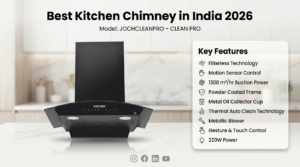

- Available in 60/75/90 cm – Curved Design
- Filter-less Technology – No filter replacement needed
- Motion Sensor Technology – Touchless operation
- Maximum Suction: 1300 m³/hr – handles heavy Indian cooking
- Powder Coated Frame – Durable & rust-resistant
- Metal Oil Collector Cup – Easy grease collection
- Thermal Auto Clean Technology – Self-cleaning function
- Metallic Type Blower – Powerful & long-lasting
- Gesture & Touch Controls
- Auto Clean with Oil Collector & Filterless design
- Power: 220 W
SMOKE PURE
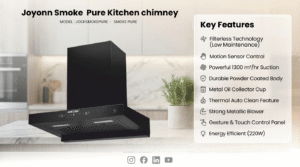
- Available in 60/75/90 cm – T-Shape Design
- Filter-less Technology – Zero recurring filter cost
- Motion Sensor Technology – Hygienic touchless use
- Maximum Suction: 1300 m³/hr – built for Indian kitchens
- Powder Coated Frame – Premium & durable finish
- Metal Oil Collector Cup – Separates grease cleanly
- Thermal Auto Clean Technology – Minimal maintenance
- Metallic Type Blower – High efficiency motor
- Gesture & Touch Controls
- Auto Clean with Oil Collector & Filterless design
- Power: 220 W
Why Joyonn Chimneys are Ducted — and Why That’s the Right Call:
Both the Clean Pro and Smoke Pure are fully ducted chimneys designed to expel all smoke, grease, and cooking odours completely outside your kitchen. With 1300 m³/hr suction capacity, filterless technology (meaning no carbon filter replacement — ever), and thermal auto-clean function, these are built to handle daily Indian cooking without the recurring costs or performance drop that ductless chimneys suffer from. If you’re looking for the best ducted chimney in India at this specification level, these models are hard to beat.
Buying Tips Before You Decide
Before you place an order — ducted or ductless — these are the factors that genuinely affect satisfaction after purchase. Skip any of these and you’ll likely regret it.
1. Suction Capacity (m³/hr)
This is the single most important spec. For Indian cooking, don’t go below 1000 m³/hr. Light continental-style cooking can get by with 600–800 m³/hr, but if you cook with mustard oil, heavy masalas, or fry regularly — 1200–1300 m³/hr is what you actually need. Joyonn’s models offer 1300 m³/hr, which is at the top end for residential use.
2. Chimney Size vs Hob Size
The chimney should always be at least as wide as your cooking hob, ideally slightly larger. For a 2-burner hob, 60 cm works. For a 3–4 burner hob, go for 75 cm or 90 cm. A chimney smaller than your hob will miss smoke from the outer burners.
3. Filter Type
Baffle filters and mesh filters (used in ducted chimneys) need cleaning every 2–3 months — just wash with warm water and detergent. Carbon filters (ductless chimneys) need full replacement every 3–6 months depending on cooking intensity. Filterless technology, like what Joyonn offers, eliminates both concerns.
4. Auto-Clean Function
This is not a gimmick — it genuinely matters for long-term performance. Auto-clean chimneys heat the collected oil, liquify it, and drain it into a collector cup. This prevents grease buildup inside the chimney body, which is the biggest cause of motor failure in chimneys. Both Joyonn models include thermal auto-clean as standard.
5. Noise Level
Chimney noise is rated in dB. Under 58 dB is acceptable for most people. The noise mainly comes from the blower motor and duct airflow. Metallic blowers (as in Joyonn’s models) tend to be more durable and maintain consistent performance compared to plastic blowers, though the initial noise is similar.
6. Duct Length and Bends
For ducted chimneys, every bend in the duct pipe reduces effective suction by roughly 10–15%. Try to keep duct runs straight and short — ideally under 2 metres, with no more than 2 bends. Work with a professional installer to plan the optimal route before installation.
Our Final Verdict
For Indian households — and for most kitchen setups where ducting is possible — a ducted chimney is the clear winner. It removes air completely rather than recycling it, costs less to maintain over time, and actually handles the demands of real Indian cooking.
Ductless chimneys have their place: rented flats, compact kitchens with no external wall access, or very light cooking use. But if you’re cooking daily Indian meals, ductless will frustrate you within a year — with lingering odours, saturated carbon filters, and declining performance.
Joyonn’s Clean Pro and Smoke Pure are both ducted, filterless, and built with 1300 m³/hr suction — specifically because we believe Indian kitchens deserve chimneys that actually work, not ones that just look good on a spec sheet.
Frequently Asked Questions (FAQ)
Ductless chimney vs duct chimney — which is better?
For most Indian households, a ducted chimney is better. Here’s the straight answer: a ducted chimney physically removes all smoke, cooking odours, heat, and moisture from your kitchen by expelling the air outside. A ductless chimney only filters the air and pushes it back in — which means odours are reduced but not eliminated, and heat/moisture stay in the kitchen.
The only situation where ductless makes more sense is when ducting isn’t possible — such as a rented flat where you can’t drill walls, or a kitchen with no external wall access. In every other case, go ducted.
- Ducted = air exits your kitchen → better air quality, lower maintenance
- Ductless = air stays in kitchen → partial odour reduction, higher filter costs
Ductless vs ducted kitchen chimney pros and cons — summary
Ducted Chimney Pros: Completely removes smoke and odours from kitchen, removes heat and moisture, much lower annual maintenance cost, no carbon filter replacement, best performance for heavy Indian cooking.
Ducted Chimney Cons: Requires one-time duct installation, needs external wall or roof access, may need permission in rented homes.
Ductless Chimney Pros: No duct installation needed, easier setup, portable, suitable for rented apartments.
Ductless Chimney Cons: Air stays inside kitchen, only partial odour removal, carbon filters need replacement every 3–6 months (₹1,500–₹4,000/year), performance drops as filters saturate, not ideal for daily Indian cooking with heavy spices or frying.
Ductless vs ducted kitchen chimney in India — which works better for Indian cooking?
Indian cooking is among the most demanding in the world for kitchen chimneys — high heat, strong spice aromas, frequent frying, and the heavy smoke from mustard oil or ghee-based cooking. For this kind of cooking, a ducted chimney is strongly recommended in India.
Ductless chimneys with carbon filters can manage light odours, but when it comes to deep frying, tadka, or regular masala cooking, the carbon filters get overwhelmed quickly and need replacement far more frequently. Ducted chimneys handle all of this without any recurring filter cost.
This is exactly why Joyonn builds ducted, filterless chimneys — because we understand what Indian kitchens actually demand.
Best ducted chimney in India — what should I look for?
When choosing the best ducted chimney in India, focus on these key specifications:
- Suction Power: Minimum 1000 m³/hr for Indian cooking; 1200–1300 m³/hr is ideal
- Filter Type: Filterless or baffle filter (avoid mesh-only for heavy cooking)
- Auto-Clean Function: Thermal auto-clean prevents grease buildup and extends motor life
- Size: Match to hob width — 60, 75, or 90 cm
- Blower Type: Metallic blower for longevity and consistent suction
- Brand Support: Warranty, spare parts availability, and service network in India
Joyonn’s Clean Pro and Smoke Pure models tick all these boxes with 1300 m³/hr suction, filterless technology, thermal auto-clean, and a metallic blower — making them strong contenders for the best ducted chimney in India in their category.
Ductless vs ducted kitchen chimney price — which is more affordable?
Ductless chimneys often appear cheaper upfront — but when you calculate the total cost over 3–5 years, ducted chimneys typically cost less overall.
- Ductless chimney: Product ₹5,000–₹20,000 + Carbon filter replacement ₹1,500–₹4,000/year = potentially ₹15,000–₹40,000 over 5 years
- Ducted chimney: Product ₹8,000–₹30,000 + Duct installation ₹1,500–₹3,500 (one-time) + filter washing ₹200–₹500/year = potentially ₹10,000–₹36,000 over 5 years
Add to that the fact that ducted chimneys actually clean your kitchen air completely — and the value equation for ducted becomes even clearer. If you choose a filterless ducted chimney like Joyonn’s models, the long-term maintenance cost drops to almost nothing.
The ductless vs ducted kitchen chimney debate doesn’t really have a complicated answer for most Indian buyers. If you can install a duct — do it. You get better air quality, lower maintenance costs, and a chimney that actually handles what Indian cooking throws at it. Ductless chimneys are a practical workaround for specific situations, not the ideal long-term solution for a heavy-use kitchen.
At Joyonn, we’ve built our chimney lineup around this understanding. Our Clean Pro and Smoke Pure are fully ducted, filterless, and designed with 1300 m³/hr suction — because that’s what Indian kitchens deserve. No carbon filter replacement. No recurring costs. Just clean kitchen air, every single day.
If you’re still unsure which model or size is right for your kitchen layout, feel free to reach out to our team — we’re happy to help you find the best kitchen chimney in India for your specific setup.