Key Benefits of Electric Induction Cooktops
Let us face facts; we have all grown up seeing Mom and Grandmother cooking food on gas stoves. Hearing the clicking noise while igniting the stove, seeing the blue flame underneath the pressure cooker, and smelling the tadka splashing hot oil into it — these experiences are very common. Hence when the suggestion comes of using an electric induction cooktop, doubt creeps in.
However, as soon as the advantages of electric induction cooktops are known, all doubts melt away within no time. If you are a home owner and contemplating buying a new cooktop, a dealer looking to sell appropriate products and a distributor keen on understanding what the consumers of India prefer, then this guide is especially for you!
So, What Exactly Is an Electric Induction Cooktop?
Before moving on to the advantages of using an induction cooker, it would be useful to understand the mechanism behind its work – because then everything else will become clear.
A modern induction cooker heats neither the burner nor the flame. Using electromagnetic technology, it heats the pot or pan placed on top of it directly. The cooking plate does not become hot at all – only your utensil heats up. And when you take the vessel off the surface, it immediately stops.
Imagine the process like this: in the case of a conventional gas cooker, you heat the air, the burner, the surrounding environment, and ultimately your food. In the case of a device with induction technology, this entire chain is bypassed – only the vessel and the food inside it are heated.
The above-mentioned fact alone is the source of nearly all the advantages of using an induction cooker compared to a conventional gas stove.
You’ll Notice the Difference on Your Electricity Bill
Let’s get to the point, which is money.
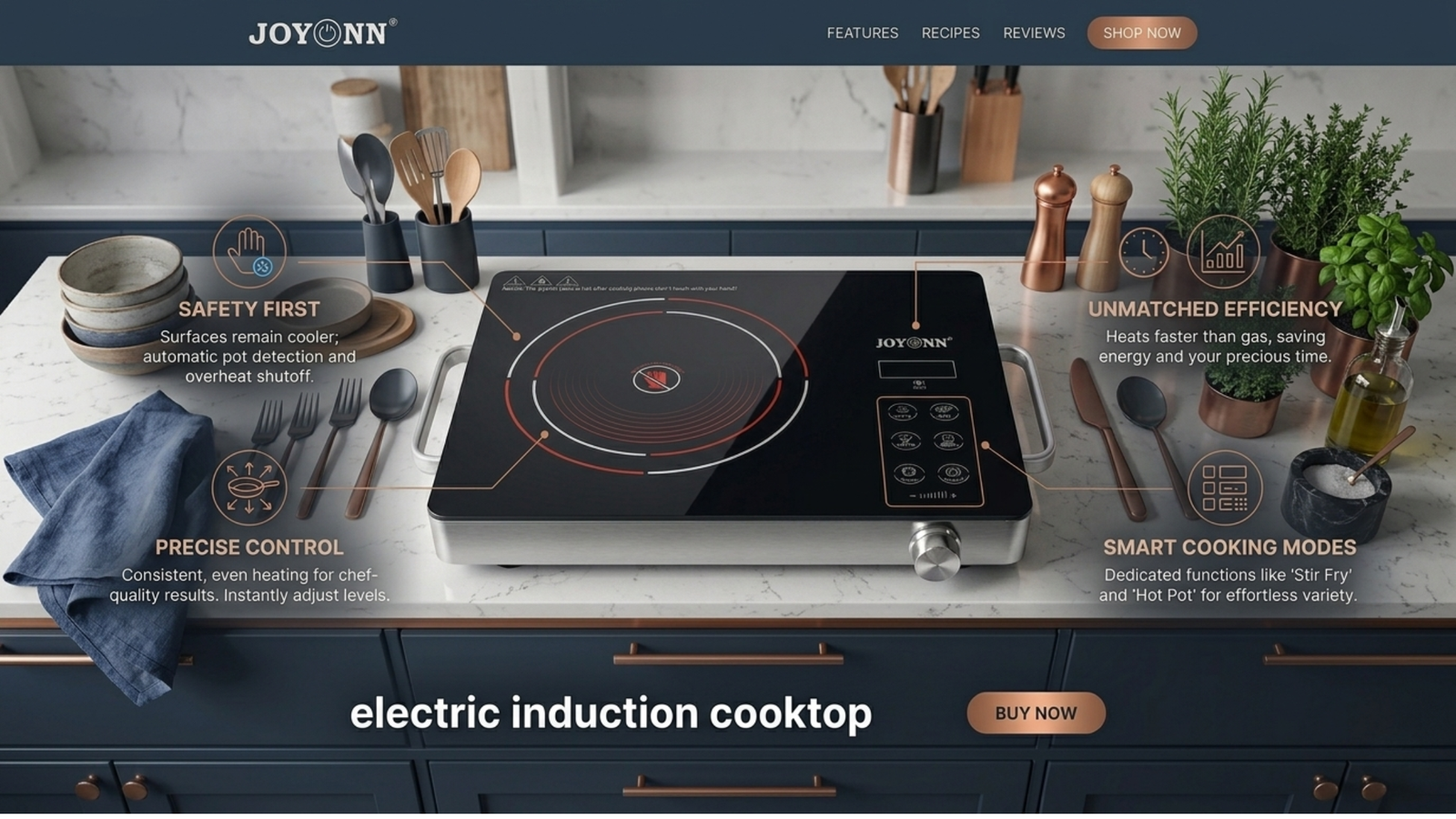
It is perhaps safe to say that the biggest motivator for Indians adopting induction cooktops is energy savings. Even good gas stoves waste a lot of energy since the flame heats not only the bottom of the pot but also the kitchen itself. Induction stoves have an approximate rating of 85–90% thermal efficiency. In contrast, gas ranges achieve around 40–55% efficiency.
How do these numbers affect you?
Foods heats up quicker, thus saving you cooking time
Energy wastage is minimized, and hence reflected in reduced consumption
For Indian households which use their cooking stoves thrice a day, such savings translate into something tangible in a few months
As always with such things, take it with a grain of salt — your savings will be dependent upon your tariffs, frequency of cooking, and type of the cooker itself. Always verify the star rating of the stove by the Bureau of Energy Efficiency before purchase.
For dealers and distributors, this is a genuinely easy point to make to customers. Efficiency is something people feel month after month, and it builds long-term satisfaction with the product.
It’s Genuinely Safer — Especially If You Have Kids or Elderly at Home
- This is the benefit which would be closest to the hearts of Indians, and rightfully so.
- A gas stove has dangers associated with it: gas leakage, accidental fires, burning clothes and leaving the gas stove turned on even after finishing the cooking process. These are actual cases that take place in everyday households. When it comes to safety, the electric induction cooker cannot be matched.
- Why?
- No flame at all. There will be zero risk of leakage, any problems related to cylinders and clothes catching fire.
- Cool surface. Since the heat is generated inside the vessel placed on it, not the surface itself, this part stays relatively cool. In case you have children at home, it will be much safer for them to touch it rather than an actual burning stove.
- Automatic shut off function is a common feature of modern cookers – when there is no vessel or time is up, the appliance will shut down on its own.
- Locking the appliance to avoid accidental turning it on is available in more models than before.
- There is no need to deal with cylinders anymore – a huge bonus for people residing in apartments and lacking reliable cylinder delivery services.
Consumer reviews across Amazon India and Flipkart consistently mention safety as a top reason Indian buyers — particularly young parents and those with elderly family members — choose induction over gas. If you’re a dealer, this is a conversation worth having with your customers.
Cleaning Takes Two Minutes, Not Twenty
Asking any person who has tried cleaning the interior of their gas burner after a spill from a curry, it surely was no pleasant experience. The food debris clogged inside the grate, the oil spilling into every corner, and the burner cap which is never really clean.
With an induction cooktop, all of these hassles will be gone.
Since there is no grate, burner, or any other such part, whatever spills onto the cooking surface is simply lying on top of it. The heat generated in the induction cooktops isn’t sufficient enough to scorch spills as it happens in a gas burner.
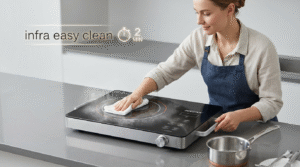
Cleaning is just as simple: just a quick swipe with a wet cloth after cooking, and it is all set to go again.
Even for tough stains, use a commercially available induction cooker cleaner (commonly available in Indian household and appliance stores), and you will find your cooktop looking as good as new within a few minutes.
A tip for cleaning: always let your induction cooktop cool down first, and try not to scratch its glass surface using abrasive cleaners.
It is one of those benefits which dealers should highlight but customers might not ask for. but once you mention it, their eyes light up. Especially working women and busy households, it’s a very real quality-of-life improvement.
How Much Does an Induction Cooktop Actually Cost in India?
This is where the surprises start coming in. Induction cooktops available in India are much more affordable than most people would imagine. Here’s a price comparison based on categories:
Affordable induction cooktops (Bajaj, Usha, Pigeon): ₹1,200 to ₹2,500. Sufficient for normal cooking needs and entirely dependable for a small family.
Mid-range induction cooktops (Joyonn, Philips, Prestige, Havells,): ₹2,500 to ₹5,000. These have superior wattage settings, auto-cooking modes, and more robust surfaces.
High-end induction cooktops (Bosch, premium Prestige, Pigeon): More than ₹5,000. Best for intense usage, in-built countertop mounting, or the most discerning customers.
Please note that these are merely estimations. It is advisable to cross-check with your nearest dealer or on brand-specific websites for accurate MRPs since these keep fluctuating with market dynamics.
However, there is something more important to consider when comparing costs. You should not just focus on the price of buying an induction cooker. Think about how much money you pay every month on refilling LPG cylinders, any servicing charges that might come up occasionally, and energy savings due to greater efficiency. Over a year or two, induction cooktops become quite economical – even remarkably so in some cases.
For distributors supplying dealers across Tier 2 and Tier 3 cities, having products across all three price segments is key. The entry-level buyer in a smaller town and the premium kitchen buyer in a metro have very different budgets, but both are genuinely interested in the switch.
Installation Is Almost Embarrassingly Simple
This is something that will really amaze you. As compared to a gas cooker, which requires connecting cylinders, checking the regulator, checking the piping, and a visit by a technician, setting up an induction cooktop on the counter top takes no more than thirty seconds.
You simply keep it on a flat surface on your counter top and plug it into any normal electricity connection of 230v. There you go – you’re ready to cook.
No gas pipeline involved. No cylinders involved. No venting system required either.
This is great news for people who are shifting houses and setting up kitchens for themselves. For the dealers too, this is good news because their customer will be able to purchase one in the morning and cook on it the same evening itself!
There’s only one exception – for the buyers of built-in induction cook tops for a kitchen renovation project, a separate circuit must be checked by the electrician as per the wattage requirement. But, for most of the customers, it will simply be plug-and-play.
But Will It Work for Indian Cooking?
That is the question which almost every Indian person will ask regarding induction cooking – and rightfully so. Indian cuisine involves high temperatures and cooking in several vessels at once, along with things like pressure-cooking and deep frying.
The answer is a resounding ‘yes’, but only if you have the right cookware.
Most of the middle and high-end appliances provide an option to regulate wattage output from 200W to 2000W. This means that, by adjusting the power output of induction cookers, you can make your meals from mild simmering till boiling.
But there is a condition – induction cookers require cookware which is suitable for use in this appliance. In this case, the cookware should have a flat bottom surface made of metal which responds to magnetic field – most often, such cookware as stainless steel or cast iron.
A quick test whether your cookware is suitable or not is to attach a magnet onto its surface – if the magnet stays attached, you have got the right cookware.
Fortunately, Indian cookware brands like Prestige, Hawkins and Vinod provide special series of pressure cookers and tawas compatible with induction cooking technology.
Frequently Asked Questions
Q1. What are the main benefits of electric induction cooktops for Indian households?
These include high efficiency, safety, and ease of cleaning. An induction cooking stove heats food more quickly, uses less power, doesn’t use a flame, and is much easier to clean than a gas stove. For Indian households that prepare several meals per day, the advantages really make a difference.
Q2. Are induction cooktops more energy efficient than gas stoves?
Yes, significantly. Induction ranges have been reported to have an energy efficiency level of about 85% to 90%, whereas gas ranges only have an energy efficiency of about 40% to 55%.
Q3. Is induction cooking safe for homes with children or elderly family members?
In fact, it is one of the safest ways of cooking food. There is no flame involved in the process; it doesn’t get as hot as a gas stove and has safety mechanisms like automatic shut-off and locking. But all other precautions used in the kitchen remain valid.
Q4. How do induction cooktops compare in price to gas stoves in India?
Induction cookers at the lower end of the price spectrum cost roughly ₹1,200, which is on par with the initial prices for ordinary gas burners. However, when you consider the expenses of LPG gas, deposits for the cylinders, and other maintenance expenses, induction cookers prove to be a more economical choice in the long run.
Q5. How do I clean and maintain an induction cooktop?
It is much simpler compared to that of a gas stove. With the absence of grates and burners, all one needs is just a wet cloth to clean up most of the messes in the day-to-day cooking process. For more stubborn messes, apply a manufacturer-recommended cleaner that is non-abrasive in nature.
Q6. Will my existing Indian cookware work on an induction cooktop?
This entirely depends on the type of vessel you have. Induction cooking requires that your vessel be made from material that can conduct electricity, such as stainless steel or cast iron. A quick test to find out whether your vessel is suitable for use on an induction stove is to try attaching a magnet to its base – if it sticks, you’re good to go!
Conclusion
If you’ve read this far, the answer is pretty clear — electric induction cooktops are a smart upgrade for Indian kitchens. Faster cooking, lower energy bills, better safety, zero installation headache, and a surface that cleans up in minutes. Whether you’re a homeowner ready to make the switch or a dealer looking to stock what customers are actively asking for, induction cooking is a direction worth moving in — sooner rather than later.
Buy in Bulk? Joyonn Home Appliances Has You Covered
For dealers and distributors across India, Joyonn Home Appliances is your go-to partner for quality induction cooktops at competitive bulk prices. With products built for Indian kitchens, flexible ordering options, and dependable after-sales support, Joyonn makes it simple to stock smart and sell confidently.
📧 Inquiries & Orders: info@joyonn.com 📧 Support: support@joyonn.com 📞 Call / WhatsApp: +91 88260 60090
Reach out today for pricing, catalogues, or dealership opportunities — the Joyonn team is ready to help.